Blog 2 – All About Experiential Learning
Experiential learning, is the way people learn through active physical practicing rather than just following instructions from an instructor in a classroom. It involves a learner to experience, reflect, think, and act. This encourage learners to find out whether the subject they’re studying is even interesting enough for the learner to dive deeper or not, because the learner gets to experience the subject hands on not just through a lecture. It is one of the most common methods of learning across all fields and industries, especially when it comes to but not limited to sports. It is a proven fact that experiential learning is the best way to learn physical subjects like sports or other professional skills like trades.
In sports experiential learning is crucial, for example, if someone wants to learn how to play badminton, how effective would it be to have the person say sit in a classroom while an instructor explains how the game works if the person does not actually participate in the sport with the equipment. Sure, a classroom would be great for an absolute beginner to explain the rules and standards of the sports, but to actually learn and get good at the sport, the only way is to actually actively participate and engage in the sport, even for just practice such as practicing how to swing a racket, effective ways to move across the court, even if repetitive, it is still a way of experiential learning. That is a case of experiential learning in action that provides an important example in how experiential learning works.
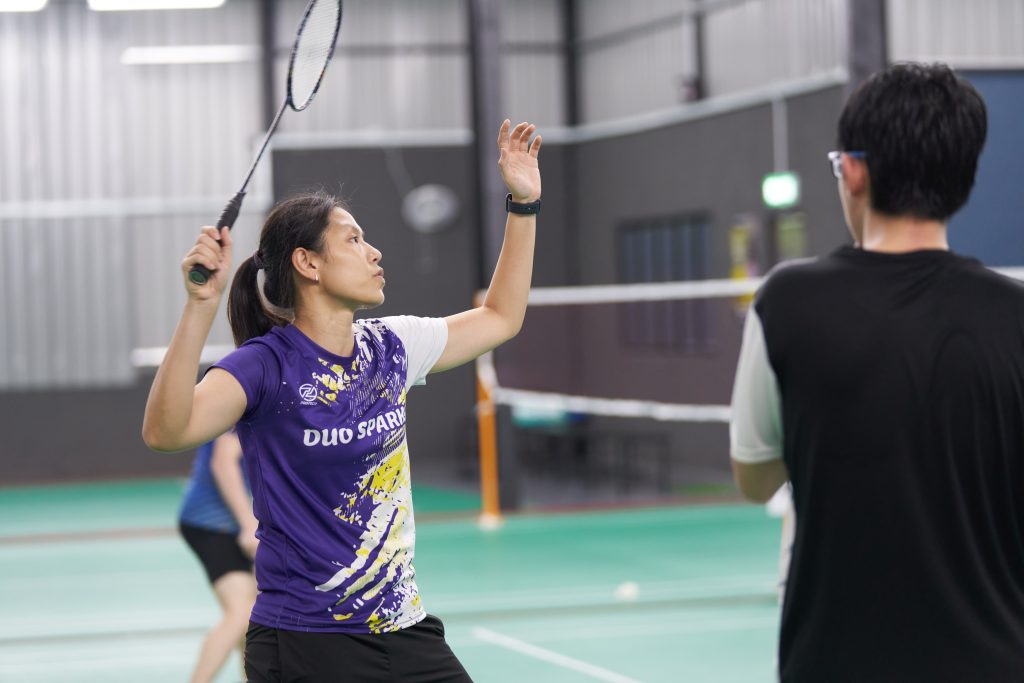
A student practicing how to project badminton birds with an instructor
When it comes to my own experience with experiential learning, say when I learned music, bringing back the experience from the last blog, it felt less boring and actually more engaging and encouraging to actually play the piano than to just sit in a classroom and listen to an instructor explaining the instrument. Even music theory can involve experiential learning, I found music theory much easier to comprehend when we engaged with our actual musical instruments to say demonstrate a chord, a scale, or a sound relationship compared to say that same idea was presented on a screen or board. Experiential learning incorporates both visuality and physicality, which naturally encourages a learner to engage with their body and their mind. When a concept of music theory is explained without context, it becomes boring, and not only that, also harder to comprehend. When that same concept is explained with real world concepts using existing music and perhaps letting learners to demonstrate that same concept on their instruments, not only did it make learning more fun and engaging but also more effective. This also proves that experiential learning can take multiple forms, it can still involve screens, but in the case of self paced RCM music theory which was how I got to level 8, their software allows students to actively interact with each taught concept, the exercises are also interactive often with other existing songs for instance despite all being on a screen. This is a much more immersive and engaging way of acquiring a new skill compared to the way where a video or an article provides the concept and instructions and the learner only fills in the blanks on a worksheet as how most associate with digital learning.

Overall, I believe experiential learning is one of the most important ways to learn. It allows for hands on approach, seeing progress in real time, finding the right topic interest, and better retention. In many subjects such as sports and learning a musical instrument, experiential learning is in fact the only possible physical way to learn as explained above.
References:
- Kolb, DAvid A. “What Is Experiential Learning?” Institute for Experiential Learning, November 19, 2025. https://experientiallearninginstitute.org/what-is-experiential-learning/.
- Lian, Shuaiyu. “Experimental Research on Badminton Teaching of Physical Education Major Based on Deep Learning in the Multimedia Environment.” Computational intelligence and neuroscience, March 16, 2022. https://pmc.ncbi.nlm.nih.gov/articles/PMC8942625/.
- Alicia. “11 Benefits of Experiential Learning.” Global Summers Academy, June 21, 2021. https://globalsummersacademy.com/2021/07/11-benefits-of-experiential-learning/.
Hi Michael,
I really liked how you explained experiential learning through sports and music. Your badminton example made the idea very clear. It is true that no one becomes skilled just by listening to rules. Actually practicing is what builds real understanding.
I also appreciated how you connected it to learning piano. When you described understanding music theory better by playing chords and scales yourself, it showed how experience and action deepen learning. That connects well to the idea that learners need to experience and reflect in order to truly understand concepts.
Your example of the RCM digital software was interesting, too. It shows that experiential learning does not always have to be fully physical. Interactive digital tools can still create meaningful engagement when learners are actively involved and receiving feedback.
Your post made me think about how combining some instruction with hands-on practice might create the strongest learning design. Overall, you clearly showed why experiential learning can be powerful and motivating.